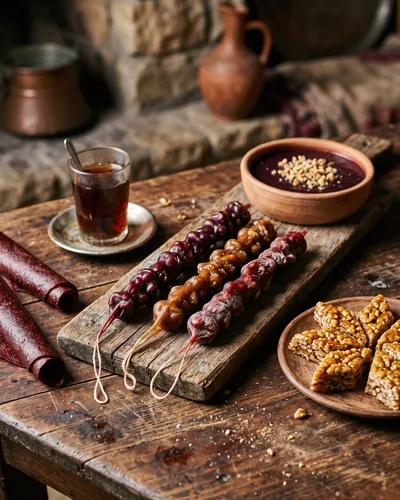
Churchkhela: What It Is and Where to Buy It in Tbilisi
Georgia's grape-and-walnut stick: the kinds, how to pick a good one and what to pay

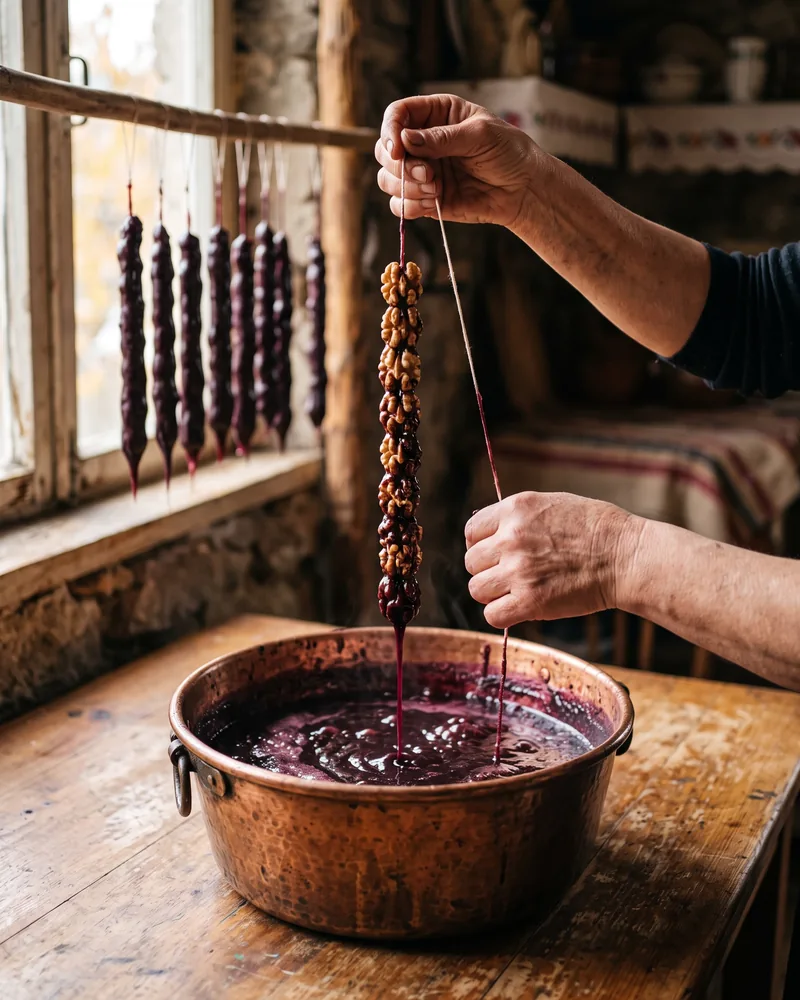
Churchkhela is walnuts threaded on a string, dipped again and again in grape must thickened with flour, then hung up until the coat sets into a chewy stick about the length of your forearm. You'll see it in bunches at every bazaar in the city. Here's what's in it, the walnut and hazelnut kinds, what to do about the string, how to spot a good one, what to pay and where to buy it.
Quick summary
- Churchkhela is walnut halves or hazelnuts on a 20 to 35 cm string, dipped several times in tatara (grape must thickened with flour) and dried for days.
- The Kakhetian kind has walnuts and wheat flour; western Georgia's janjukha uses hazelnuts and corn flour and gets 1 more dip after 10 days.
- It's made once a year, after the September and October grape harvest, and keeps for months somewhere dark and dry.
- The 10-second check: a good one is matte and firm but still bends, and a white dusty bloom on it is sugar, not mould.
- Bazaar stalls charge less than souvenir shops, and one producer sells a Kakhetian-style walnut stick online for 4 GEL.
- It's vegan by recipe, the cotton string inside isn't for eating, and as a solid it's exempt from the 100 ml liquid rule at airport security.
What churchkhela is
Georgia's tourism board defines the coat, tatara, as sweet condensed grape juice boiled with wheat flour, so the whole recipe is grape, flour and nuts. English speakers call it Georgian Snickers for the shape and the nuts inside, and that's where the likeness ends.
The tourism board says Georgian soldiers carried it on campaign because it's filling and keeps so long. The name is protected too: churchkhela is on Georgia's register of geographical indications with chacha and sulguni, and its specification lets it be made anywhere in the country but nowhere else.
How churchkhela is made
Churchkhela belongs to the grape harvest, rtveli, which runs from September into October. Most of the juice goes off to become Georgian wine, the skins and pips go into the still for chacha, and some of the juice goes into a wide pot to be boiled down.
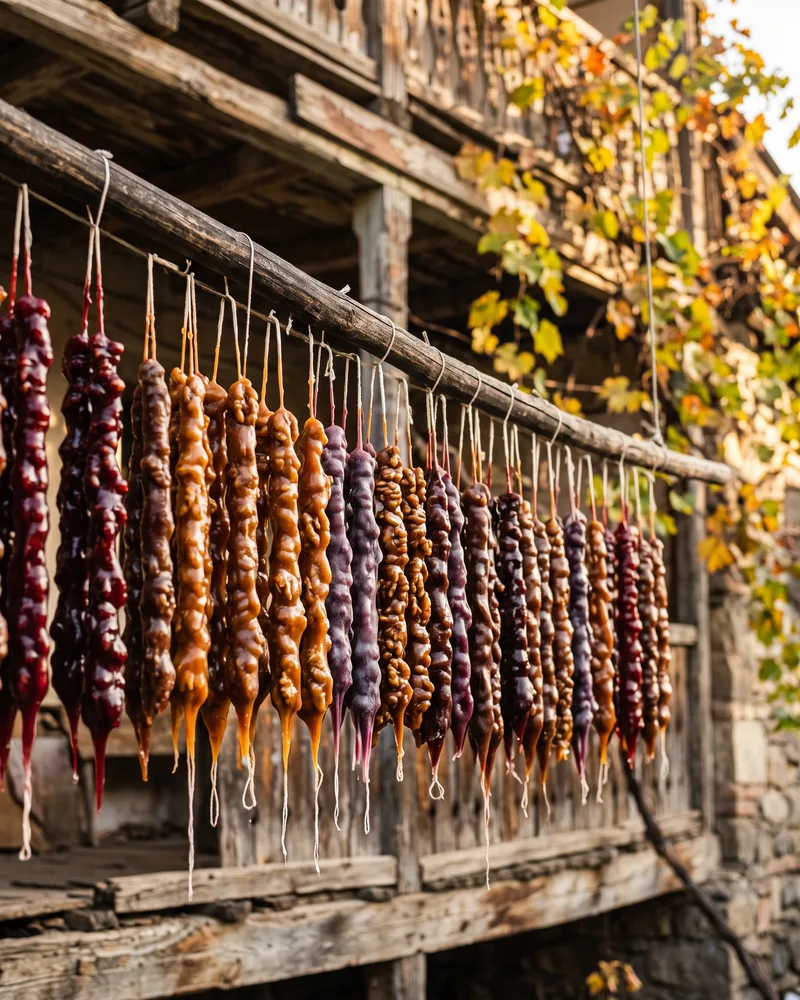
The boiled-down must is badagi, and once flour is stirred in, it thickens into tatara. Strings of nuts are lowered into the hot tatara, lifted out, left to set and dipped again until the coat is thick, then hung up for days to dry, and one producer's listing says its sticks spend 4 to 5 of them in the sun.
The same pot feeds the table without the nuts. Tatara is eaten as a pudding, and grape must set with corn meal is pelamushi, the other autumn staple among Georgian desserts.
Walnut, hazelnut and the other kinds of churchkhela
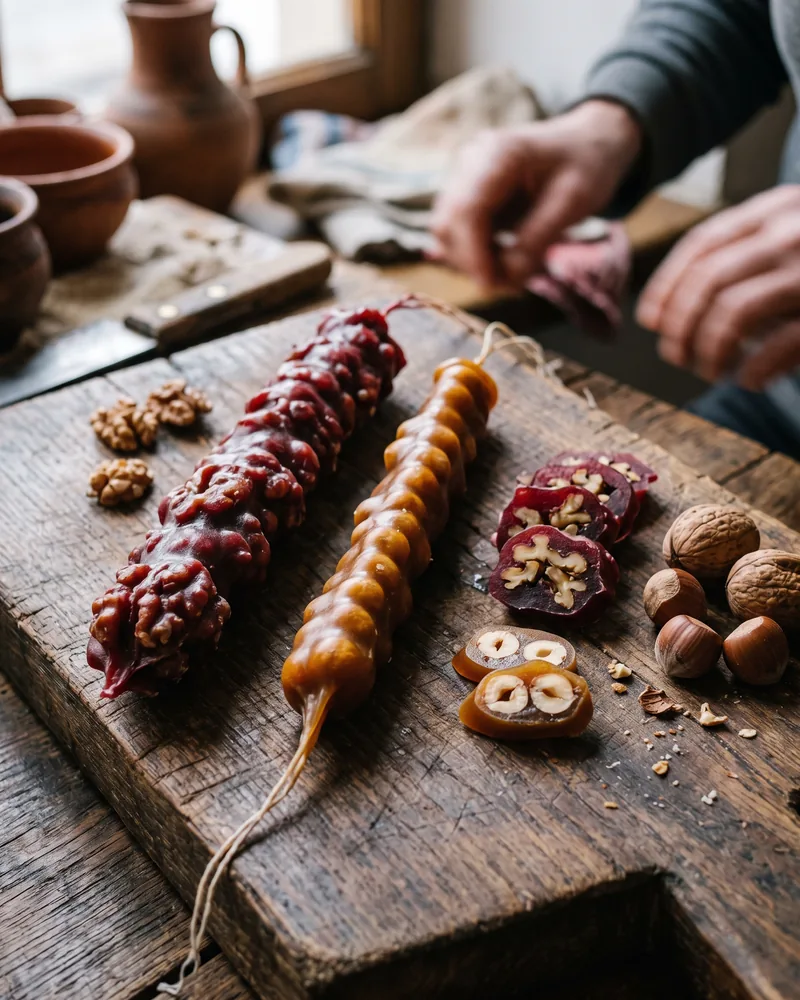
The kind you'll meet first is Kakhetian, with walnut halves inside, and the tourism board calls it the most popular. Western Georgia's janjukha swaps in hazelnuts and a must thickened with corn flour instead of wheat, and gets 1 more dip 10 days in, before it dries.
| Kind | From | Inside | What it looks like |
|---|---|---|---|
| Kakhetian | Kakheti, in the east | Walnut halves, in wheat-flour tatara | Fat and knobbly, with walnut shapes under the coat |
| Janjukha | Western Georgia | Hazelnuts, in a corn-flour must | Slimmer, with a neat row of round bumps |
| Racha-style | Racha, a mountain region in the west | Dried fruit, apricots or pumpkin seeds | Irregular, so ask what's inside |
The colour comes from the grapes. Must from a white grape such as rkatsiteli sets amber and red grapes take it dark red to purple, while the specification also allows mulberry juice, so a stick in a shade no grape or mulberry makes is worth a question.
How to eat churchkhela
Expect chewy, not crunchy: the coat bends like a firm fruit jelly and the nut inside does the crunching. It's an afternoon snack with a glass of Georgian tea, a last bite after a long dinner and a fixture on the New Year table.
It's also the rare bit of Tbilisi street food that survives a day in your coat pocket. For a table, slice it into rounds about 1 cm thick so every piece shows its nut.
How to pick a good churchkhela
Churchkhela keeps for months, so the stick in front of you could be this autumn's or last autumn's. These checks take 10 seconds.
| Check | Buy it | Think twice |
|---|---|---|
| Surface | Matte, maybe with a faint white dust | A wet-looking gloss: very fresh, or coated in syrup |
| White bloom | An even, dusty film of crystallised sugar | Fuzzy green or blue spots, which are mould |
| Bend | Firm, but gives a little when you flex it | Rock hard, or it snaps: old and dried out |
| Nuts | Bumps all the way down the string | Long smooth stretches: more must than nut |
| Colour | Amber, dark red or purple | A shade no grape makes: ask what's in it |
| Packet | Grape must, flour and nuts | A longer list: read it, especially if you're vegan |
Where to buy churchkhela in Tbilisi
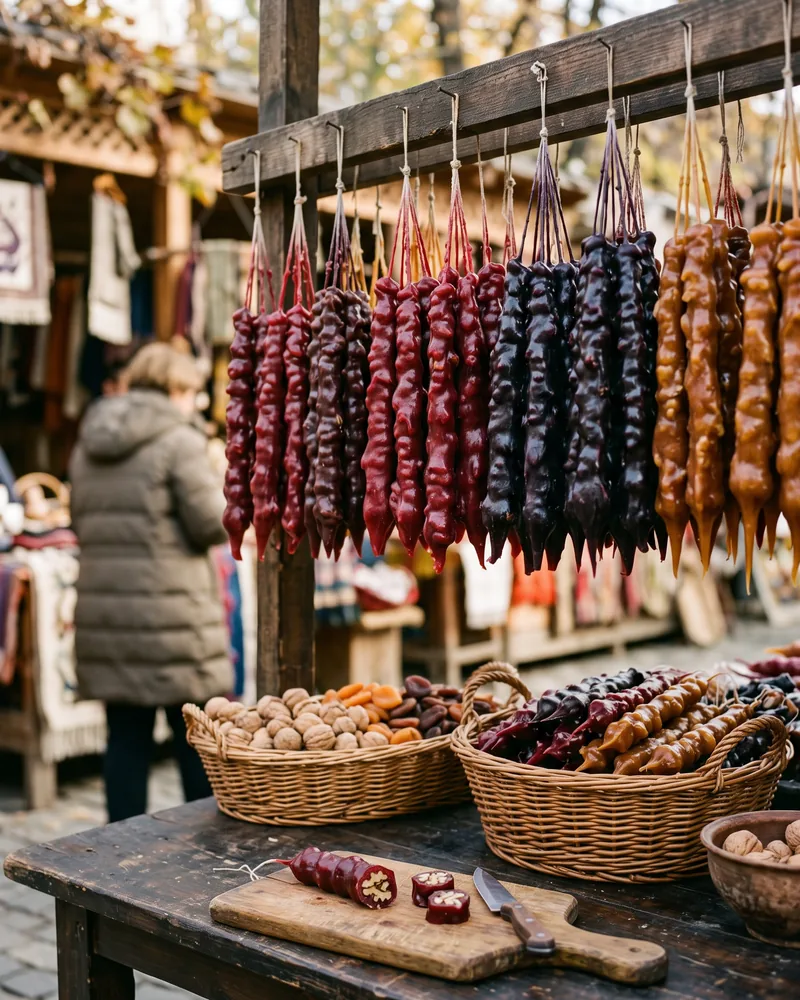
Every bazaar in Tbilisi has a churchkhela stall, usually strung up in bunches over the dried fruit and nuts, and a stall charges less than a souvenir shop for the same stick. For one data point, a producer lists a Kakhetian-style walnut stick at 4 GEL on a website that sells direct from Georgian farmers.
The wine shops are the easier stop if you're buying a bottle anyway, and 2 on our list have churchkhela on record. Ge-Wine, on Uznadze Street, closes at 7:30 PM, so make it a daytime errand.
The cooking classes on our list are built around khinkali and khachapuri, and churchkhela doesn't come up in their reviews. To dip your own, the one class on record is at Sancho, a wine bar and shop on Akhvlediani Street.
In October, the Tbilisoba festival puts up stalls selling churchkhela and janjukha next to pelamushi and tklapi, and the tourism board names Europe Square as one of the spots. It's the easy way to try the walnut and hazelnut kinds side by side.
Taking churchkhela home
Churchkhela is about the easiest edible souvenir to fly with. It's a solid, so the 100 ml liquid rule at airport security doesn't touch it, and it keeps for months somewhere dark and dry, which is how the tourism board says to store it.
It also has no meat or dairy, which the EU won't let travellers bring in from Georgia, and Great Britain's rules say the same. The honey and jam that travel with it are fiddlier, since Georgian food souvenirs that pour or spread count as liquids at security. Buy the churchkhela last and keep it in your cabin bag.
Frequently asked questions
What is churchkhela made of?
Nuts, grape must and flour. Walnut halves or hazelnuts are threaded on a cotton string and dipped several times in grape must boiled down and thickened with wheat or corn flour. The protected specification also allows almonds, pumpkin seeds or dried fruit on the string, and mulberry juice in place of grape.
Why is churchkhela called Georgian Snickers?
Because it's a long bar with nuts inside, and that's the whole resemblance. There's no chocolate, caramel or nougat: the coat is grape must set with flour, and the nuts are walnuts or hazelnuts. Nobody at a stall needs the nickname, so just ask for churchkhela, ჩურჩხელა in Georgian.
How much does churchkhela cost in Tbilisi?
One producer lists a traditional Kakhetian-style walnut churchkhela online at 4 GEL a stick, which gives you a yardstick at the stall. Bazaar stalls usually charge less than souvenir shops for the same thing, so buy the bulk of your gifts at a stall and save the shop for the last-minute one.
Do you eat the string in churchkhela?
No. The cotton thread runs through the middle and holds the nuts together while the stick is dipped and dried, and it stays behind as you eat. Pull it out as you go, or slice the stick into rounds and pick the bit of thread out of each one.
How long does churchkhela keep, and can it fly?
It keeps for months somewhere dark and dry, and it can fly in either bag. An older stick is firmer rather than spoiled, and a white, dusty bloom is sugar, though fuzzy green or blue spots mean mould. As a solid it's exempt from the 100 ml liquid rule, and it has no meat or dairy for customs to stop.
Is churchkhela vegan?
Yes, by recipe: grape must, flour and nuts, with no honey, dairy or eggs. That also makes it Orthodox fasting food, the same rule that shapes so much vegetarian Georgian food. Factory-made sticks can add other ingredients, so read the packet if you're strict.