Georgian Breakfast: What Georgians Eat and Where to Try It in Tbilisi
Bread, cheese and tea at home, syrniki and khachapuri in town, and the few kitchens open before 9 AM

A Georgian breakfast is mostly assembled, not cooked: bread, cheese, butter, an egg, jam or honey and a pot of black tea, plus yesterday's khachapuri if any survived. Georgian food saves its real effort for dinner. This page covers the home table, the cooked dishes from kikliko to chirbuli, the cafe favourite, syrniki, and which Tbilisi kitchens serve it, hour by hour.
Quick summary
- At home it's bread, cheese, butter, eggs, jam or honey and black tea, plus 1 cold wedge of yesterday's khachapuri if there's one left.
- The cooked dishes are kikliko (bread fried in egg), chizhi-bizhi (eggs scrambled with tomato and onion) and chirbuli, 5 eggs in butter with garlic and sour plum, from Adjara.
- Syrniki, fried cottage cheese pancakes, are the cafe breakfast: 126 Google reviews name them at Chaduna and 89 at Sali Coffee.
- Only 6 of the 15 places on our breakfast list open by 9 AM, and Gisho Specialty Coffee is the earliest at 7:30 AM.
- The cheapest Georgian breakfast is from a bakery: a large shoti was 1.30 GEL at Tone in 2025, and a khachapuri 3 GEL at Caravanserai Bakery in 2026.
What is a traditional Georgian breakfast?
Georgia doesn't have a big breakfast tradition, because its food culture is built around dinner. Paul Rimple, writing about Tbilisi for Culinary Backstreets in 2021, puts the weekday morning at leftover bread and butter, a piece of cheese or a day-old khachapuri.
That's the weekday, and it takes longer to boil the kettle than to lay the table. The cooked dishes further down this page are what a slower morning adds, when someone has the time, a pan and a guest to feed.
What Georgians eat for breakfast at home
The bread is shotis puri, the long loaf with pointed ends baked on the wall of a clay tone oven, bought from the bakery round the corner and torn, not sliced. Next to it goes cheese, usually imeruli or sulguni, the 2 everyday Georgian cheeses: imeruli fresh and crumbly, sulguni brined, layered and stretchy.
Matsoni, Georgia's fermented milk, is the sweet end of the table, eaten from a bowl with honey on top. It's one of the Georgian names protected abroad, on the National Intellectual Property Center's list alongside Sulguni and Imeretian Cheese.
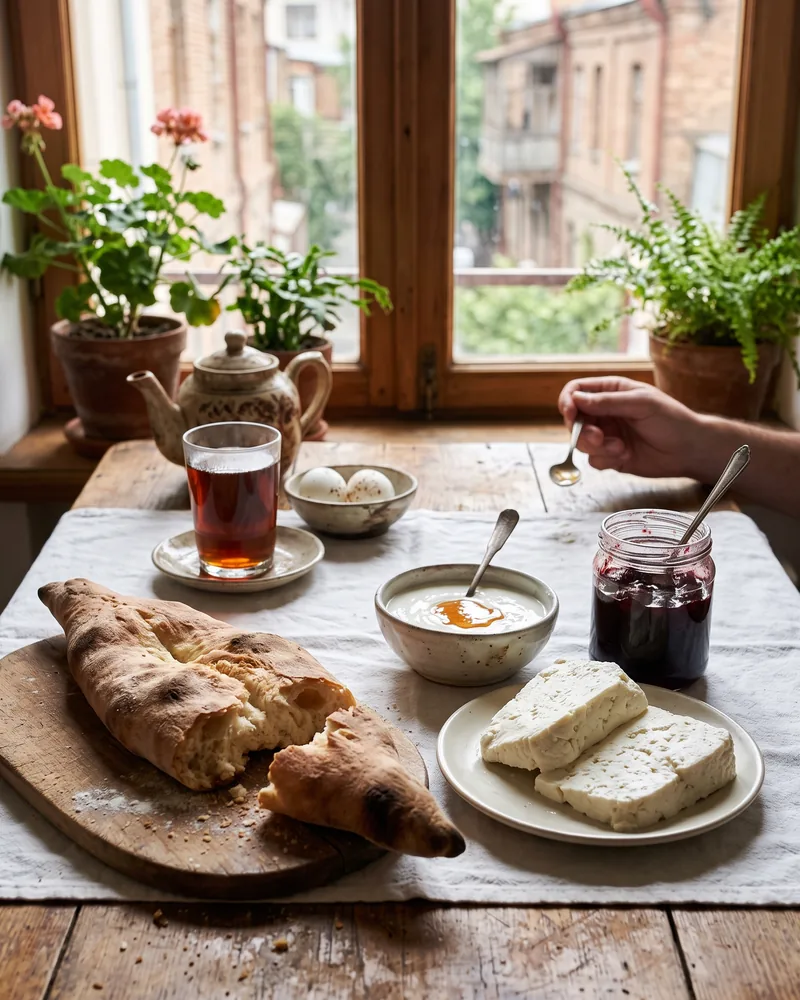
To drink, it's usually black tea. Georgian tea grows in the wet west of the country, and Tkibuli Mountain Tea sits on the same protected list as matsoni.
Kikliko, the Georgian French toast
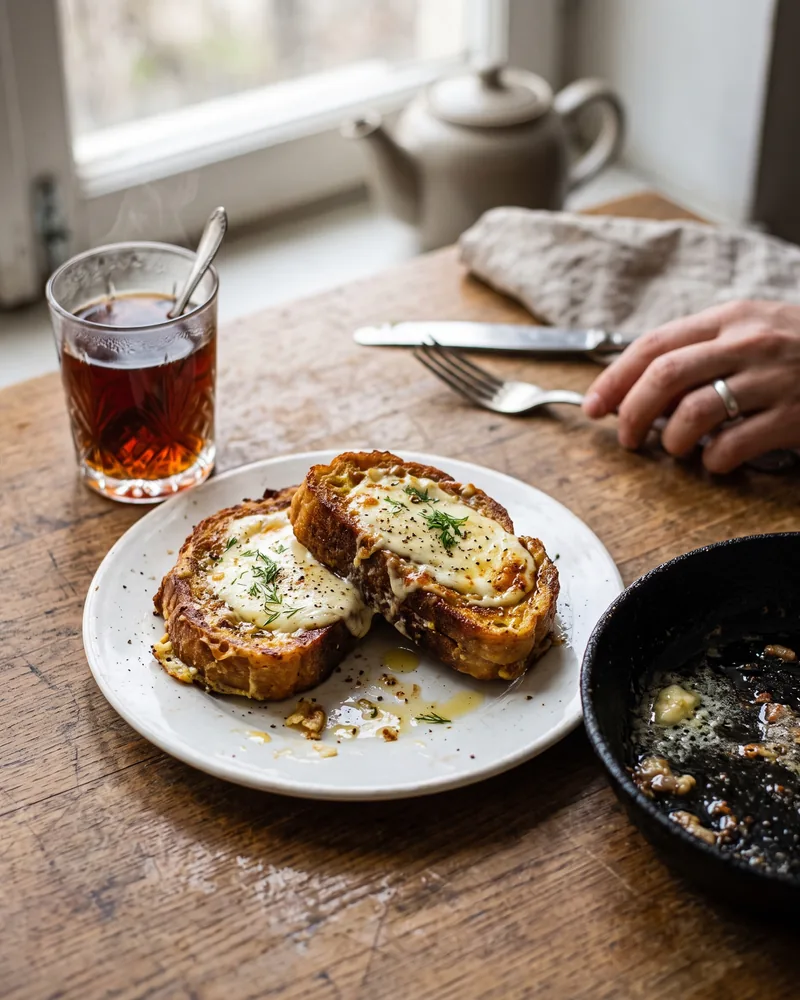
Kikliko is bread soaked in beaten egg and fried in a pan, Georgia's version of French toast, and it usually goes savoury, with cheese, rather than sweet. The name copies a rooster's crow, which tells you what time of day it's for.
Chirbuli, chizhi-bizhi and borano: the egg and butter dishes
Chirbuli comes from Adjara, on the Black Sea, and the tourism board lists it among the dishes found only there. Its recipe is 5 eggs in well-boiled butter or erbo, the clarified kind, with salt, boiling water, 3 cloves of garlic and a splash of sour plum juice.
The versions you'll meet elsewhere often add tomato and crushed walnuts to the pan, and Kobuleti, on the coast, has its own chirbuli with vegetables. Think of it as shakshuka's Georgian cousin, with sour plum doing the job the spices do.
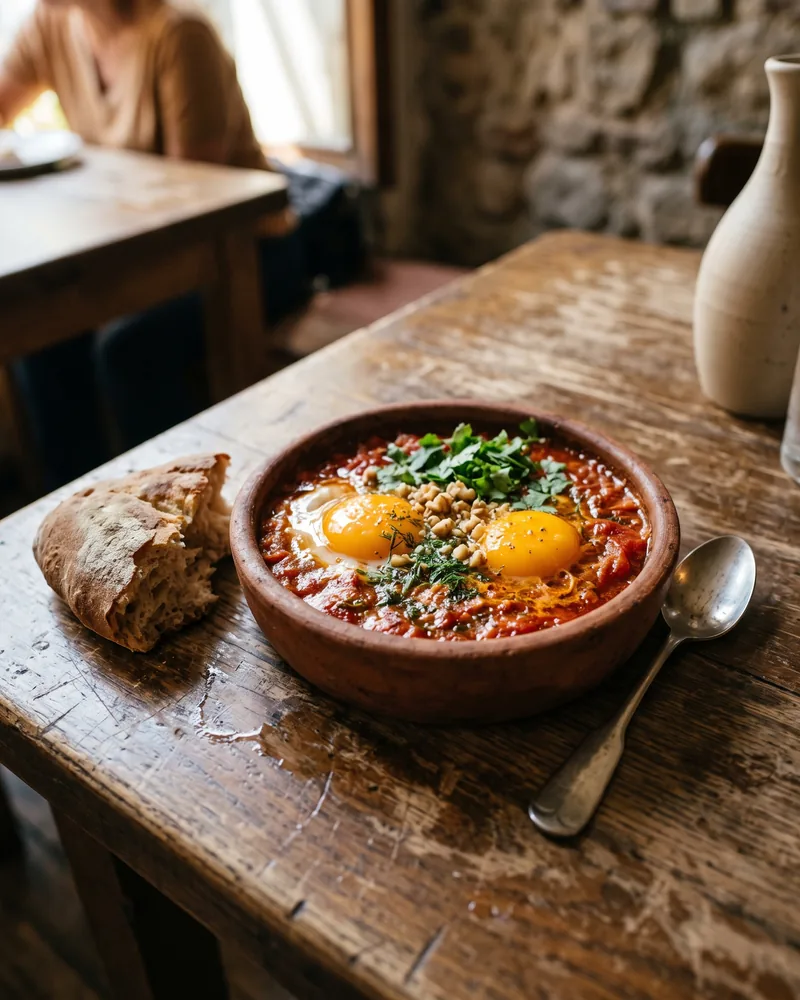
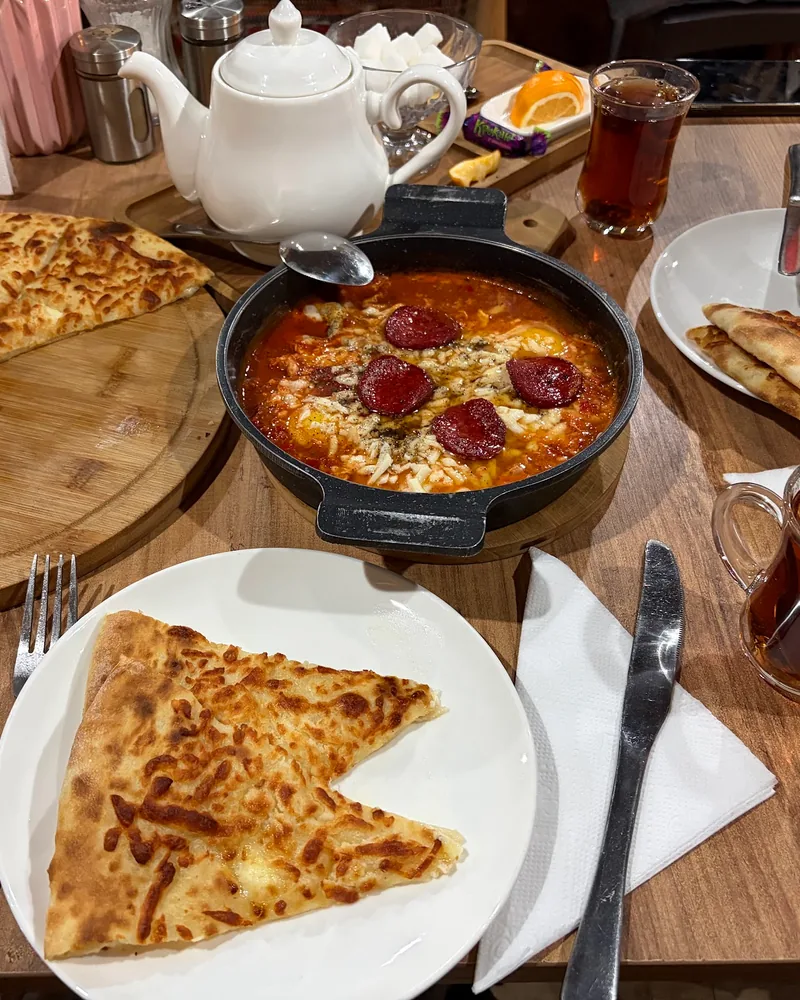
Chizhi-bizhi is the everyday one: eggs scrambled with tomato, onion and herbs in 1 pan. It's also the one you can actually order in town, and at Chaduna, near Liberty Square, 21 Google reviews name it.
Borano is the heavy one, and the tourism board says so, calling it very calorie-rich. Butter is boiled until black dots appear, which is why it's called burnt butter, then shredded cheese goes into the hot butter, and it's eaten with mchadi, the cornbread.
Syrniki, the cafe breakfast
Syrniki are small, thick cottage cheese pancakes fried in a pan, also called machkatebi, and served with sour cream, jam or fruit. They're a Soviet-era arrival rather than a village recipe, and they've been on Tbilisi cafe menus long enough that nobody asks.
They're the dish Tbilisi's breakfast cafes get judged on. At Chaduna, 126 Google reviews name them, more than any other dish, and they're a fixture at the cafes you can work from too.
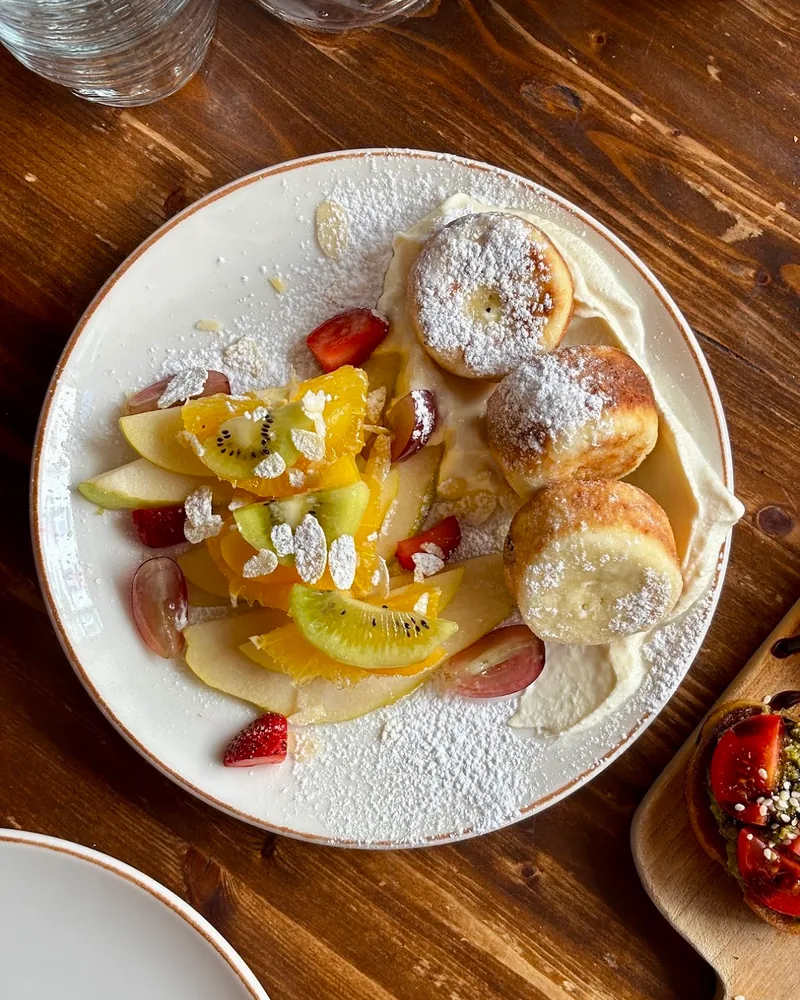
The move, from one Chaduna reviewer, is eggs and cheese with a plate of syrniki and fruit on the side. If you'd rather eat outside, pick Zilina Cafe, a Tbilisi cafe with its own courtyard garden, where one reviewer found the best syrniki they had in Georgia.
Do Georgians eat khachapuri for breakfast?
Yes, though usually yesterday's. A cold wedge of Imeruli khachapuri, the round one the tourism board calls the most widespread kind, is as Georgian a breakfast as anything cooked that morning.
The Adjarian boat is a bigger commitment: an egg yolk and butter on a pool of hot cheese, stirred together and scooped up with torn crust. Save it for a late breakfast that's turning into lunch, and share it.

The fastest Georgian breakfast is a khachapuri or a lobiani, the bean-filled one, handed over in paper at one of the bakeries. One reviewer paid 3 GEL for a khachapuri at Caravanserai Bakery, opposite the History Museum, in January 2026.
Go early. Breadbar Bakery in Vake-Saburtalo opens at 8 AM, and one reviewer warns that by the afternoon the good things have sold out.
Where to eat a Georgian breakfast in Tbilisi, by opening time
Tbilisi wakes up late: only 6 of the 15 breakfast and brunch spots we ranked open by 9 AM. Here's the morning from the earliest door to the latest.
| Opens | Where | What to order |
|---|---|---|
| 7:30 AM | Gisho Specialty Coffee, Old Tbilisi | Coffee and a sandwich in the garden |
| 8 AM | Badagoni, Liberty Square | A Georgian breakfast, served until 12 PM |
| 8 AM | Tone (Georgian Bakery), Old Tbilisi | Shoti to take away, fresh loaves from about 9 AM by one review |
| 8 AM | Breadbar Bakery, Vake-Saburtalo | Gurian khachapuri or an almond croissant |
| 9 AM | Friendly Corner, Old Tbilisi | Shakshuka or khachapuri with brewed tea; shut Mondays |
| 9 AM | Chaduna, Old Tbilisi | Syrniki and chizhi-bizhi |
| 9 AM | Family Kitchen Tar Tun, Old Tbilisi | Khachapuri and home cooking from the counter |
| 10 AM | Crossroads Bistro, Sololaki | Syrniki or draniki, the potato pancakes |
| 10:30 AM | Cafe Irioni, Isani-Samgori | Adjarian khachapuri and loose-leaf tea |
| 11 AM | Caravanserai Bakery, Old Tbilisi | Lobiani, or a khachapuri (3 GEL in January 2026) |
Frequently asked questions
What is kikliko?
Kikliko is bread soaked in beaten egg and pan-fried, Georgia's version of French toast, usually savoury with cheese. The name imitates a rooster's crow. It's a home dish for using up yesterday's bread, and nothing on our lists has it on record, so it's easier to make than to find.
What is chirbuli?
Chirbuli is an egg dish from Adjara. The tourism board's recipe is 5 eggs in well-boiled or clarified butter with salt, boiling water, 3 cloves of garlic and a little sour plum juice. Versions with tomato and crushed walnuts are common, and Kobuleti makes its own with vegetables.
What are syrniki, and where do you get them in Tbilisi?
Syrniki are fried cottage cheese pancakes with sour cream, jam or fruit. Chaduna is the obvious address, with 126 Google reviews naming them and the door open from 9 AM. Sali Coffee's come up in 89 reviews, and one Zilina Cafe reviewer called theirs the best in Georgia.
Do Georgians eat khachapuri for breakfast?
Yes, usually a cold wedge of yesterday's Imeruli at home. Out, the fastest version is a bakery khachapuri or lobiani in paper, 3 GEL at Caravanserai Bakery by one reviewer's count in January 2026. Save the Adjarian boat for a late breakfast that turns into lunch.
What time does breakfast start in Tbilisi?
Later than you'd think: only 6 of the 15 places on our breakfast list open by 9 AM. Gisho Specialty Coffee is earliest, at 7:30 AM every day, Badagoni serves a Georgian breakfast from 8 AM to 12 PM, and the Tone and Breadbar bakeries open at 8.
Is khashi a breakfast?
Yes, as the morning-after one. The tourism board says khashi, the tripe soup eaten with crushed garlic, is often offered at the start of the day, especially to the hungover. It belongs to the morning after a long night; an ordinary morning is still bread, cheese and tea.